Our People
-
-
© CBM/argum/Einberger
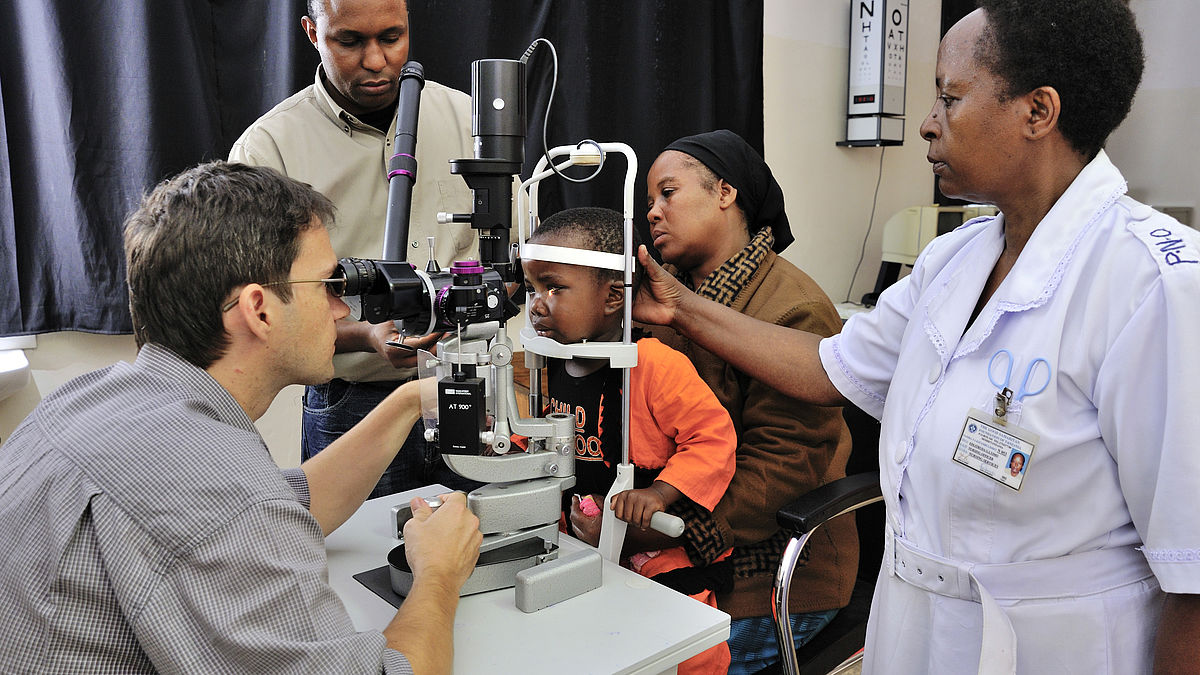
CBM's Dr. Heiko Philippin and his team examine the eyes of Joyce (who had a successful bilateral cataract operation) at the KCMC Hospital, Tanzania
CBM employs specialists in a multitude of disciplines, both in the field as co-workers and within the departments of the International Office, and the emphasis is on training national staff.
Supporting partner organisations
-
©CBM
-
CBM co-worker Moges Teshome who is an ophthalmologist in DRC
CBM employs trained specialists in the fields of disability and development, project management and other medical and professional fields to support the goal of improving the quality of life of persons with disabilities.
In 2010, 95 experts supported partner organisations as employees of CBM. Among them were ophthalmologists; orthopaedic surgeons; ear, nose, and throat specialists and inclusion experts in addition to the many local eye nurses, physiotherapists, and other experts working for CBM.
These postings are described as co-workers assisting in programmes worldwide and priority is given to postings where it is possible to train national staff.
The role of CBM International Office
CBM has Member Associations. They work together in one joint international programme managed by CBMeV. They also work together with CBM International (CBMI) to promote resource mobilisation for the CBM Family.
The CBM Assembly of Members is made up of representatives of the Member Associations, who appoint the CBMeV and CBMI Boards. The CBMeV and CBMI Boards advise and supervise the Senior Leadership Team (SLT). The Senior Leadership Team manages CBMeV and CBMI (the International Office).
The Extended Leadership Team consists of the SLT, Executive Directors of the Member Associations and Regional Directors of the Regional Programme Offices.
Extract from CBM's Objective-setting Process, 2007
"We all deeply feel our joint responsibility to improve the quality of the lives of the people with disabilities we serve.
"We want to make CBM the most effective and efficient organisation possible in order to achieve our goal of significantly impacting the problem of disability and poverty throughout the developing world.
"We have identified through our Basic Beliefs that transparency and openness, together with respect, are important components of our CBM culture. Formalizing the dialogue process in all areas of the organisation is an important part of implementing our vision plan and making it a a reality.
"An underlying goal of this dialogue process is to build mutual trust and understanding between managers and CBM’s most valuable resource – its employees."