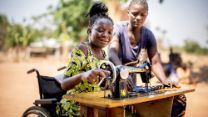
Persons with disabilities are falling through the social safety net

On the International Day of Persons with Disabilities, CBM calls for disability inclusive social protection systems that support persons with disabilities. Urging governments to prioritise disability inclusion, CBM addresses the urgent need for financial independence, access to education, and decision-making roles for persons with disabilities, emphasising that social protection is a fundamental human right.

Ashish, 33, built a beekeeping business through the Atmanirbhar Shamoodhay initiative with support from CBM India and Sanjeevani. He now earns his own income, supports others, and speaks up for stronger social protection.

Over a billion people worldwide live with a disability, most of whom lack a social safety net. Those living in poverty and with a disability have minimal chances of receiving support during crises. Today, on the International Day of Persons with Disabilities, CBM is calling on governments worldwide to take this into account in development cooperation and national social protection systems. 

We live in an increasingly volatile world, characterised by frequent crises. But too often, persons with disabilities are left alone when faced with challenges that could affect their health, their livelihood or their ability to support their family. 3.8 billion people worldwide have no access to social security, and this particularly affects persons with disabilities or those living in poverty.  

The employment rate for men and women with disabilities is significantly lower than that for persons without disabilities. At the same time, globally only about one in three persons with severe disabilities receive any form of disability benefit - and even then, support is often inadequate. In Sub-Saharan Africa and Southern Asia, coverage falls to fewer than one in ten. This lack of income security is particularly concerning, as persons with disabilities typically face additional expenses for care and support, accessible transportation, assistive technologies, and higher medical needs. While most countries do have systems in place, they are frequently poorly designed, underfunded, insufficient, and overburdened. 

Social protection is a human right

The theme of this year’s International Day of Persons with Disabilities is fostering disability inclusive societies for advancing social progress. 

CBM calls for comprehensive and responsive disability inclusive social protection systems so that persons with disabilities are effectively supported and included and can better manage risk in their lives. This is first and foremost a state responsibility. At the same time, non-governmental approaches can help supplement and fill gaps in state provision.

To this end, the work of CBM and its partners – from income-generating measures such as vocational training to inclusive health, disaster preparedness and humanitarian aid - strengthens the resilience of persons with disabilities and their families. 

CBM advocates for inclusive, barrier-free social protection systems at the national and international levels because social protection is a human right, not charity. All persons with disabilities should be able to live safely and participate meaningfully in their communities.