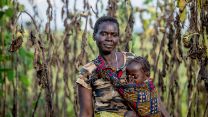
Six-year-old Regina from Zambia has a physical disability and relies on her grandmother, Florence, for care. This challenges their household, but they are committed to providing Regina with the best care possible.

69.8 million people reached as CBM and partners advanced disability inclusion in 2025

The CBM Annual Report 2025 records results from 385 projects in inclusive health, humanitarian action and community-based inclusive development across 35 countries.

There are two women in the picture, and the woman on the right is a wheelchair user.
Safa (left) is a member of an OPD, and Abir (right) is a community volunteer. Both work with CBM’s partner, the King Hussein Foundation, in Jordan.

CBM and our partners sustained disability-inclusive services through projects that reached 69.8 million people in 2025. Partners delivered this work amid conflict, climate-related emergencies, political uncertainty, and increasing pressure on development funding. 

Working with donors, local partners, communities and persons with disabilities, CBM supported 385 projects in 35 countries. The work focused on inclusive health care, humanitarian assistance, and community-based inclusive development. 

Local organisations responded to the priorities of their communities. At a time when financial pressures threatened to push disability inclusion down the international agenda, these partnerships helped maintain access to services and opportunities.


 The annual report records results across CBM’s three main areas of work: 

  • 59.4 million people received medicines to prevent and treat neglected tropical diseases. 
  • 8.7 million people received eye care services. 
  • 815,000 people were reached by humanitarian assistance. 
  • 296,401 people received cash and vouchers, food or essential household items. 
  • 513,097 people participated in community-based inclusive development projects. 
  • 185,772 learners enrolled in school. 
  • 8.7 mln 8.7 million people received eye care services

  • 59 mln 59.4 million people received medicines to prevent and treat neglected tropical diseases.

  • 815,000 people were reached by humanitarian assistance.

  • 513,097 people participated in community-based inclusive development projects.

Expanding access to inclusive health care

Oumer underwent a cataract surgery on both eyes at Alert Hospital and received his eyeglasses and is happy and smiling. Alert Hospital is a partner of CBM Ethiopia in Addis Ababa.
Alert Hospital is a partner of CBM Ethiopia in Addis Ababa.

An estimated 2.2 billion people worldwide live with visual impairments. In many underserved communities, limited access to screening, diagnosis and treatment means many preventable or treatable eye conditions go unaddressed. 

In 2025, CBM-supported eye care services reached 8,732,851 people. Project partners performed 485,094 eye surgeries, including 393,315 cataract operations and 9,231 procedures for children. They also distributed 298,952 pairs of glasses and other visual aids. 

With funding from RTL/Lions Deutschland, in partnership with Christian Blind Mission and Ethiopia’s Ministry of Health, ALERT Hospital opened Ethiopia's first nationally dedicated paediatric eye unit in Addis Ababa. The facility expands access to early diagnosis and specialised treatment for children at risk of avoidable vision impairment.

Strengthening economic independence

A hair dressing spraying a clients hair inside a salon. The hairdresser is standing with the support of a walking cane
Jacqueline inside her hair salon.

Community-based inclusive development (CBID) connects persons with disabilities with services and opportunities that support their rights, independence, and participation. 

In Rwanda, Jacqueline received hairdressing training and accessed loans through an inclusive village savings and loan association. She used the support to open a salon, establish a bank account, and begin saving to expand her business. 

“Before the VSLA and setting up this business, I was staying at home to support my parents. I was isolated,” she said. “Today, I know that even if I have a disability, I am capable. I can learn like others.” 

513,097 people participated in CBID projects in 2025. Among them 9,161 people obtained employment, 9,725 people were members of parent-to-parent, peer support or self-help groups, and 185,772 learners enrolled in school. 

Responding to crises

A woman wearing a red T-shirt stands next to a stack of food
Fenan Adem, a social worker with CBM’s partner OSHO in Dire Woreda, ensures vital food and supplies reach families in need.

Humanitarian crises create additional barriers for persons with disabilities, including inaccessible information and disrupted access to health care and relief services. 

CBM-funded humanitarian action reached crisis-affected communities across the globe, from Central America and Africa to the Middle East, Asia and Ukraine. Through local partnerships and flexible responses, programmes delivered life-saving assistance while helping to ensure that persons with disabilities could access and benefit from humanitarian aid on an equal basis. 

During 2025, 815,000 people received humanitarian assistance. Of these, 296,401 received cash, vouchers, food, household supplies, or hygiene products. A further 32,217 received basic medical care. 

Advocacy milestones

An audiometric technician screening infants and children for hearing loss in Guatemala

CBM contributed technical and operational expertise to advocacy supporting the adoption of World Health Assembly Resolution WHA78.7. The resolution calls for stronger prevention and integrated care for vision impairment and hearing loss across the life course. 

CBM also established an advocacy group that called for the proposed Crimes against Humanity Convention to recognise disability-based persecution and align with the Convention on the Rights of Persons with Disabilities. The group also urged states to guarantee accessibility and reasonable accommodation throughout justice processes. 

Priorities for 2026

Under Strategy 2030, CBM plans to strengthen local support systems and work more closely with organisations of persons with disabilities across its health, humanitarian and community-based programmes. 

Read the CBM Annual Report 2025 for the full results, country examples and accounts from project participants and partners. 

Download the accessible version of the CBM Annual Report 2025

  • A woman carrying a child. They are standing in front of a garden of sunflowers.

    CBM Annual Report 2025

    pdf73.2MB, Accessible

    Thanks to our donors, we supported around 69.8 million people in 35 countries. In the annual report, you will find many examples that show what your support can do.

    Download
  • CBM Financial Statement 2025

    pdf681.6KB, Not Accessible

    Click here to download the CBM Annual Financial Report 2025.

    Download