€1.5 million German-backed inclusion project starts in Sierra Leone

The German Federal Ministry for Economic Cooperation and Development (BMZ) funds a four-year plan in Sierra Leone’s north, northwest and Western area to link eye care, schools, and livelihoods for persons with disabilities

CBM has launched a €1.5 million aid programme in Sierra Leone funded by the German Federal Ministry for Economic Cooperation and Development (BMZ). The project – “Promotion of inclusive, gender-equitable and sustainable eye health, education and income-generating services in Sierra Leone” – is aimed at tackling a chain of barriers that often starts with poor vision and ends in lost schooling and income. 

CBM formally opened the programme on April 1 and 2 in Lunsar, a trading town in Port Loko District; in the northern part of the country. The area sits beyond the capital’s service network, inland from the Atlantic coast, with long stretches of rural settlements tied to rice farming, small trade, and extractive industries. Many households rely on seasonal earnings. Transport costs and distance often decide whether families seek care or keep children in school. 

Why the work starts with eye health

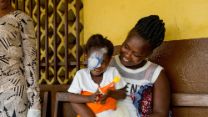
A teenage girls getting eye examination

Eye health sits at the front of the problem. Blindness affects an estimated 5.4% of Sierra Leone’s population and rises to 9.4% in the northwest, where health staffing gaps and weak referral pathways limit access to diagnosis and treatment. Cataracts account for close to 60% of cases, a reminder that much of the burden links to conditions that treatment can address when services reach people in time. Women face additional financial and information barriers and often delay care longer. 

Schools reflect the same access gap. About 23% of children live with functional impairments, yet many classrooms still lack trained support and basic accessibility. Stigma and weak implementation of inclusive education policies push children out of learning. In the six schools selected for the programme, only 6.2% of pupils currently identified have disabilities, a figure that points to under-identification, exclusion, or both. 

Economic exclusion follows. Young persons with disabilities face limited job options and few safe paths into savings and credit. When families lack access to basic financial tools, a health shock or school cost forces hard choices. 

What BMZ funding will deliver

BMZ funding backs a four-year response running from December 2025 through March 2029. The programme aims to improve eye health, educational attainment, and income opportunities, with a focus on persons with disabilities and women across Sierra Leone’s northern and northwestern provinces. CBM will deliver the work with Baptist Convention Sierra Leone and the Mental Health Coalition Sierra Leone. 

The plan sets three delivery lines. 

  1. First, it will strengthen services in six eye health facilities, focusing on diagnosis, treatment, referral, and follow-up. The goal is to reduce the need for long trips for basic care. 
  2. Second, it will support six schools to become more inclusive, translating national policy into daily practice through improved learning environments and classroom support. 
  3. Third, it will establish 20 inclusive Village Savings and Loan Associations to widen access to savings and small loans in communities where formal banking often sits out of reach. 

Programme targets

The programme targets 12,078 direct beneficiaries. That group includes persons with disabilities, with an emphasis on women and girls. It also includes 171 medical and paramedical staff trained in eye health, 11,347 pupils in six schools including 1,065 children with disabilities, and 500 members of 20 inclusive savings groups. Awareness campaigns aim to reach 2,665,000 people nationwide with messages on inclusive eye health, inclusive education, gender equality, and livelihoods. 

At the launch, Sierra Leone’s Ministry of Health on behalf of Government linked the programme to national priorities, calling it a practical extension of the National Eye Health Strategy through joint delivery for underserved communities. BMZ’s funding now turns the commitments into a test of execution across clinics, classrooms, and community finance groups.