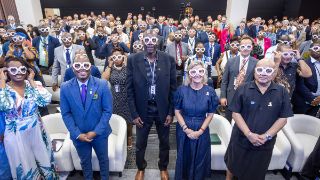
A group of about 120 people, all wearing glasses with heart-shaped lenses.

CBM and Sightsavers Commit to Reaching 100 Million People by 2030

On 2 November 2026, government leaders, international organisations, civil society and private sector representatives gathered in St John’s, Antigua and Barbuda, for the first Global Summit for Eye Health. Building on more than a decade of collaboration, CBM and Sightsavers committed to expanding inclusive vision and eye care programmes, with the shared ambition of reaching approximately 100 million people by 2030.

Convened by the International Agency for the Prevention of Blindness (IAPB), in technical collaboration with the World Health Organization (WHO), the Summit aimed to strengthen political leadership, mobilise investment and accelerate action to address the needs of more than one billion people worldwide living with avoidable vision loss.

According to IAPB’s post-Summit announcement, 200 commitments were secured, including more than US$1 billion in government financial pledges. The commitments are expected to contribute to the provision of 68 million pairs of spectacles and 13 million sight-restoring cataract surgeries worldwide.

The Summit also saw the adoption of The 1 Billion Pledge: the St John’s Global Compact for Eye Health, establishing a shared framework for continued action, collaboration and accountability.

CBM’s Eye Health Impact in Nigeria Shines at Global Summit

Senator Dr George Akume, Secretary to the Government of the Federation of Nigeria, expressed his appreciation to CBM for its SightQuest Nigeria programme. Highlighting the value of CBM’s partnership with the Nigerian Government and our continued efforts to strengthen access to affordable, comprehensive and inclusive eye health services through the ten-year programme.

CBM and Sightsavers: A joint commitment to leave no one behind

As part of the Summit, CBM and Sightsavers announced a joint commitment titled Leaving No One Behind: Advancing Inclusive Eye Health.

Building on more than a decade of collaboration, the two organisations committed to expanding inclusive vision and eye care programmes, with the shared ambition of reaching approximately 100 million people by 2030.

The commitment focuses on strengthening national health systems, integrating eye care into health, education and other development programmes, and ensuring that persons with disabilities, women and girls, people living in poverty and underserved communities are not left behind.

As part of this joint commitment, CBM has set the following measurable targets for 2027–2030:

  • Expanding access to quality eye care: Delivering 1.5 million cataract surgeries, conducting 3.52 million refractions and providing 1.2 million spectacles across our programme countries.
  • Strengthening eye health systems: Training 28,000 people, supporting the development of four national eye care plans and constructing four eye care facilities.
  • Accelerating NTD elimination: Contributing to the elimination of trachoma and onchocerciasis (river blindness) through treatment for 94 million people, training 580,000 people in neglected tropical disease (NTD) and water, sanitation and hygiene (WASH)-related activities, and providing surgical interventions to 15,800 people.

Beyond these targets, the joint commitment includes continued collaboration with WHO, support for initiatives such as SPECS 2030 and the Cataract Elimination Initiative, and advocacy for eye care to be recognised as an essential component of Universal Health Coverage (UHC).

Country leadership: Commitments across CBM-supported programme countries

One particularly encouraging outcome was the strong commitment from countries where CBM supports eye health programmes.

24 of the 35 countries where CBM work, made commitments at the Summit. This demonstrates growing national leadership and provides an important opportunity for CBM to strengthen collaboration with governments and partners in translating these commitments into practical action.

The commitments made by individual countries, including their priorities and planned actions, can be explored through the IAPB–WHO Commitment Portal.

Building momentum: CBM’s advocacy work ahead of the Summit

Throughout 2026, CBM worked alongside IAPB, Sightsavers and other partners to build political momentum for eye health and encourage national commitments ahead of the Summit.

A key milestone was the joint high-level side event “The Value of Vision: The Roadmap to the Global Summit for Eye Health”, held during the 79th World Health Assembly in Geneva on 19 May, chaired by Dr Babar Qureshi, CBM’s Director of Inclusive Health Initiative and Vice President of IAPB. Discussions focused on strengthening political leadership, integrating eye health into national health systems and translating global commitments into national action.

Beyond the Summit: Turning commitments into results

While the Global Summit for Eye Health has generated important political momentum, its long-term success will depend on how effectively commitments are implemented.

CBM will continue working with governments and partners to deliver on the commitments for 2027–2030, strengthen national eye health systems and ensure that equity, accessibility and disability inclusion remain central to programme delivery.

Ultimately, the success of the Summit will be measured not by the number of commitments made, but by the improvements in access to quality inclusive eye care for those who need it most.