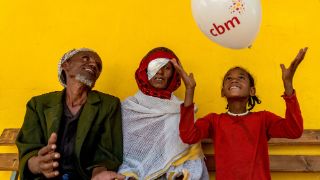
A man, a woman and a child sitting together. The child plays with a balloon, and the woman wears an eye patch over her left eye.

Inclusive health in action: 68.2 million people accessed inclusive health services in 2025

CBM and our partners reached 68.2 million people across 30 countries in 2025, while expanding health systems to provide more accessible and inclusive services. The results are detailed in CBM’s Inclusive Health Initiative Annual Report 2026.

A woman and child smiling and waving.
Emmanuel Cherujot, pictured with his grandmother Alice, received bilateral cataract surgery from CBM’s partner, Tenwek Mission Hospital in Kenya.

Health is only truly universal when it is inclusive. Yet millions of people, particularly persons with disabilities and other underserved groups, continue to face barriers to essential health services. 

Through its Inclusive Health Initiative (IHI), CBM supports governments, communities and partners to train health workers, improve services, expand community-based care and include persons with disabilities in health planning.

Published one week after our organisation-wide annual report, this health report takes a deep dive into results and learning from programmes in inclusive eye health, neglected tropical diseases, ear and hearing care, and physical rehabilitation.

CBM and our partners reached 68.2 million people across 30 countries. CBM-supported programmes delivered more than 506,000 surgeries and provided 313,000 assistive devices. We also trained 306,000 health workers, community workers and other participants to improve the availability and quality of services.

Building services that last beyond one intervention

A joyful moment in a rural community in Burundi where trachoma has been eliminated as a public health concern.

The results show how direct care, workforce development and stronger national systems work together to expand access to health services. 

Inclusive eye health programmes reached more than 8.7 million people across 25 countries through services including screening, treatment, surgery and referral. Alongside providing essential eye care, CBM is investing in the systems, skills, and workforce needed to make quality services available so communities can continue accessing quality eye care. In South Sudan, for example, CBM supports the training of local ophthalmologists to address a shortage of specialists that limits access to diagnosis, surgery and follow-up care. In Nigeria, simulation-based training allows surgeons to practise cataract procedures before operating on patients, improving their skills and supporting safer care.

CBM's NTD programmes combine preventive treatment with disease surveillance, health-worker training and support for national elimination plans. CBM-supported programmes treated more than 59 million people for neglected tropical diseases and supported countries working towards disease elimination. This figure counts doses delivered, rather than individual people reached. In the Democratic Republic of the Congo, support focused on national planning and treatment for trachomatous trichiasis, the advanced stage of the disease in which the eyelashes turn inward and damage the eye. Burundi and Egypt also received World Health Organization validation for eliminating trachoma as a public health problem.

As we look ahead, our ambition is to demonstrate inclusive approaches and to support their integration, adoption, and scale within health systems.
Dr Babar Qureshi, Director, Inclusive Health Initiative, CBM 

Ear and Hearing Care programmes reached more than 93,000 people in 11 countries through screening, treatment and referral services. By integrating screening and basic care into community and primary health services, the programmes help people receive support earlier and reduce their need to travel to specialist facilities. In Cameroon, the number of nurses trained in primary ear and hearing care rose from 3 to 112 by the end of 2025. This gives more communities access to basic screening, early treatment and referral.

Our physical rehabilitation programmes provided rehabilitation services, assistive devices and referrals to more than 43,000 people in 19 countries. Beyond treatment and the provision of assistive devices, CBM is investing in stronger rehabilitation systems and specialist capacity, so more people can receive appropriate care in their own countries and communities. In Malawi, CBM supports the new Lilongwe Institute of Orthopaedics and Neurosurgery Research and Training Centre. The centre will train specialists from Malawi and neighbouring countries, reducing reliance on training abroad and expanding access to orthopaedic and neurosurgical care.

Together, these results show why inclusive health requires more than individual treatments. Lasting progress depends on trained health workers, accessible facilities, reliable referral systems and national plans that include persons with disabilities.

“As we look ahead, our ambition is to demonstrate inclusive approaches and to support their integration, adoption, and scale within health systems.” 

Dr Babar Qureshi, Director, Inclusive Health Initiative, CBM 

Explore the results, country examples and lessons in the Inclusive Health Initiative Annual Report 2026.

  • Inclusive Health Initiative Annual Report 2026

    pdf, 10.5MB, Accessible

    The report presents the year’s results, country examples, lessons and remaining gaps in making health systems more inclusive.

    Download